


The African Union (AU) is a continental union consisting of 55 countries of the continent of Africa, with exception of various territories of European possessions located in Africa. The bloc was founded on 26 May 2001 in Addis Ababa, Ethiopia and launched on 9 July 2002 in South Africa. The intention of the AU is to replace the Organisation of African Unity (OAU), established on 25 May 1963 in Addis Ababa by 32 signatory governments. The most important decisions of the AU are made by the Assembly of the African Union, a semi-annual meeting of the heads of state and government of its member states. The AU’s secretariat, the African Union Commission, is based in Addis Ababa.
In result of its geographical location, the African Union has an area of around 29 million km2 (11 million sq mi) and includes popular world landmarks, including the Sahara and the Nile. They have adopted a gold, green and red based emblem and flag to represent the continental union, where they held a competition for citizens to design a flag in which they chose submission to replace the old flag. Their main celebration occurs on Africa Day on 25 May. The primary languages spoken include Arabic, English, French and Portuguese and the languages of Africa. Within the African Union, there are official bodies such as the Peace and Security Council and the Pan-African Parliament.
Overview
The objectives of the AU are the following:
- To achieve greater unity and solidarity between African countries and Africans.
- To defend the sovereignty, territorial integrity and independence of its Member States.
- To accelerate the political and social-economic integration of the continent.
- To promote and defend African common positions on issues of interest to the continent and its peoples.
- To encourage international cooperation, taking due account of the Charter of the United Nations and the Universal Declaration of Human Rights.
- To promote peace, security, and stability on the continent.
- To promote democratic principles and institutions, popular participation and good governance.
- To promote and protect human and peoples’ rights in accordance with the African Charter on Human and Peoples’ Rights and other relevant human rights instruments.
- To establish the necessary conditions which enable the continent to play its rightful role in the global economy and in international negotiations.
- To promote sustainable development at the economic, social and cultural levels as well as the integration of African economies.
- To promote co-operation in all fields of human activity to raise the living standards of African peoples.
- To coordinate and harmonize the policies between the existing and future Regional Economic Communities for the gradual attainment of the objectives of the Union.
- To advance the development of the continent by promoting research in all fields, in particular in science and technology.
- To work with relevant international partners in the eradication of preventable diseases and the promotion of good health on the continent.
The African Union is made up of both political and administrative bodies. The highest decision-making organ is the Assembly of the African Union, made up of all the heads of state or government of member states of the AU. The Assembly is chaired by Paul Kagame, President of Rwanda. The AU also has a representative body, the Pan African Parliament, which consists of 265 members elected by the national legislatures of the AU member states. Its president is Roger Nkodo Dang.
Other political institutions of the AU include:
- the Executive Council, made up of foreign ministers, which prepares decisions for the Assembly;
- the Permanent Representatives Committee, made up of the ambassadors to Addis Ababa of AU member states; and
- the Economic, Social, and Cultural Council (ECOSOCC), a civil society consultative body.
The AU Commission, the secretariat to the political structures, is chaired by Nkosazana Dlamini-Zuma of South Africa. On 15 July 2012, Ms Dlamini-Zuma won a tightly contested vote to become the first female head of the African Union Commission, replacing Jean Ping of Gabon.
Other AU structures are hosted by different member states:
- the African Commission on Human and Peoples’ Rights is based in Banjul, the Gambia; and
- the New Partnership for Africa’s Development (NEPAD) and APRM Secretariats and the Pan-African Parliament are in Midrand, South Africa.
The AU’s first military intervention in a member state was the May 2003 deployment of a peacekeeping force of soldiers from South Africa, Ethiopia, and Mozambique to Burundi to oversee the implementation of the various agreements. AU troops were also deployed in Sudan for peacekeeping during Darfur conflict, before the mission was handed over to the United Nations on 1 January 2008 UNAMID. The AU has also sent a peacekeeping mission to Somalia, of which the peacekeeping troops are from Uganda and Burundi.
The AU has adopted a number of important new documents establishing norms at a continental level, to supplement those already in force when it was created. These include the African Union Convention on Preventing and Combating Corruption (2003), the African Charter on Democracy, Elections and Governance (2007), the New Partnership for Africa’s Development (NEPAD) and its associated Declaration on Democracy, Political, Economic and Corporate Governance.
History
The historical foundations of the African Union originated in the First Congress of independent African States, held in Accra, Ghana, from 15 to 22 April 1958. The conference aimed at forming the Africa Day to mark the liberation movement, each year, regarding the willingness of the African people to free themselves from foreign dictatorship, as well as subsequent attempts to unite Africa, including the Organisation of African Unity (OAU), which was established on 25 May 1963, and the African Economic Community in 1981. [10] Critics argued that the OAU, in particular, did little to protect the rights and liberties of African citizens from their own political leaders, often dubbing it the “Dictators’ Club”.
The idea of creating the AU was revived in the mid-1990s under the leadership of Libyan head of state Muammar al-Gaddafi: the heads of state and government of the OAU issued the Sirte Declaration (named after Sirte, in Libya) on 9 September 1999, calling for the establishment of an African Union. The Declaration was followed by summits at Lomé in 2000 when the Constitutive Act of the African Union was adopted, and at Lusaka in 2001, when the plan for the implementation of the African Union was adopted. During the same period, the initiative for the establishment of the New Partnership for Africa’s Development (NEPAD), was also established.
The African Union was launched in Durban on 9 July 2002, by its first chairperson, South African Thabo Mbeki, at the first session of the Assembly of the African Union. The second session of the Assembly was in Maputo in 2003, and the third session in Addis Ababa on 6 July 2004.
Since 2010, the African Union eyes the establishment of a joint African space agency.
Barack Obama was the first ever sitting United States president to speak in front of the African Union in Addis Ababa, on 29 July 2015. With his speech, he encouraged the world to increase economic ties via investments and trade with the continent and lauded the progress made in education, infrastructure and economy. But he also criticized lacks of democracy and leaders who refuse to step down, discrimination against minorities (LGBT people, religious groups and ethnicities) and corruption. He suggested an intensified democratization and free trade, to significantly increase living quality for Africans.
Demographics
Languages
According to the Constitutive Act of the African Union, its working languages are Arabic, English, French and Portuguese, and African languages “if possible”. A protocol amending the Constitutive Act, adopted in 2003 but as of June 2016 not yet ratified by a two-thirds majority of member states, would add Spanish, Swahili and “any other African language” and declare all “official” (rather than “working”) languages of the African Union. The Executive Council shall determine the process and practical modalities for the use of official languages as working languages.
Founded in 2001 under the auspices of the AU, the African Academy of Languages promotes the usage and perpetuation of African languages among African people. The AU declared 2006 the Year of African Languages. 2006 also marked Ghana’s 55th anniversary since it founded the Bureau of Ghana Languages originally known as Gold Coast Vernacular Literature Bureau.
Politics
The African Union has a number of official bodies:
- Pan-African Parliament (PAP)
- To become the highest legislative body of the African Union. The seat of the PAP is at Midrand, South Africa. The Parliament is composed of 265 elected representatives from all 55 AU states and intended to provide popular and civil-society participation in the processes of democratic governance. Its president is Roger Nkodo Dang, of Cameroon.
- Assembly of the African Union
- Composed of heads of state and heads of government of AU states, the Assembly is currently the supreme governing body of the African Union. It is gradually devolving some of its decision-making powers to the Pan African Parliament. It meets once a year and makes its decisions by consensus or by a two-thirds majority. The current chair of the AU is Rwandan President Paul Kagame.
- African Union Commission (or Authority)
- The Secretariat of the African Union, composed of ten commissioners and supporting staff and headquartered in Addis Ababa, Ethiopia. In a similar fashion to its European counterpart, the European Commission, it is responsible for the administration and coordination of the AU’s activities and meetings.
- Court of Justice of the African Union
- The Constitutive Act provides for a Court of Justice to rule on disputes over interpretation of AU treaties. A protocol to set up this Court of Justice was adopted in 2003 and entered into force in 2009. It was, however, superseded by a protocol creating an African Court of Justice and Human Rights, which will incorporate the already established African Court on Human and Peoples’ Rights (see below) and have two chambers: one for general legal matters and one for rulings on the human rights treaties.
- Executive Council
- Composed of ministers designated by the governments of member states. It decides on matters such as foreign trade, social security, food, agriculture and communications, is accountable to the Assembly, and prepares material for the Assembly to discuss and approve. It is chaired by Mr Shawn Makuyana of Zimbabwe (2015–).
- Permanent Representatives’ Committee
- Consisting of nominated permanent representatives of member states, the Committee prepares the work for the Executive Council, similar to the role of the Committee of Permanent Representatives in the European Union.
- Peace and Security Council (PSC)
- Proposed at the Lusaka Summit in 2001 and established in 2004 under a protocol to the Constitutive Act adopted by the AU Assembly in July 2002. The protocol defines the PSC as collective security and early warning arrangement to facilitate a timely and effective response to conflict and crisis situations in Africa. Other responsibilities conferred to the PSC by the protocol include prevention, management and resolution of conflicts, post-conflict peacebuilding and developing common defence policies. The PSC has fifteen members elected on a regional basis by the Assembly. Similar in intent and operation to the United Nations Security Council.
- Economic, Social and Cultural Council
- An advisory organ composed of professional and civic representatives, similar to the European Economic and Social Committee. The chair of ECOSOCC, elected in 2008, is Cameroonian lawyer Akere Muna of the Pan-African Lawyers Union (PALU).
- Specialised Technical Committees
- Both the Abuja Treaty and the Constitutive Act provide for Specialised Technical Committees to be established made up of African ministers to advise the Assembly. In practice, they have never been set up. The ten proposed themes are: Rural Economy and Agricultural Matters; Monetary and Financial Affairs; Trade, Customs, and Immigration; Industry, Science and Technology; Energy, Natural Resources, and Environment; Transport, Communications, and Tourism; Health; Labour, and Social Affairs; Education, Culture, and Human Resources.
- Financial institutions
- African Central Bank – Abuja, Nigeria
- African Investment Bank – Tripoli, Libya
- African Monetary Fund – Yaoundé, Cameroon
These institutions have not yet been established, however, the Steering Committees working on their founding have been constituted. Eventually, the AU aims to have a single currency (the Afro).
- Human rights
- African Commission on Human and Peoples’ Rights, in existence since 1986, is established under the African Charter on Human and Peoples’ Rights (the African Charter) rather than the Constitutive Act of the African Union. It is the premier African human rights body, with responsibility for monitoring and promoting compliance with the African Charter. The African Court on Human and Peoples’ Rights was established in 2006 to supplement the work of the Commission, following the entry into force of a protocol to the African Charter providing for its creation. It is planned that the African Court on Human and Peoples’ Rights will be merged with the Court of Justice of the African Union (see above).
- African Energy Commission
Membership
All UN member states based in Africa and on African waters are members of the AU, as is the disputed Sahrawi Arab Democratic Republic (SADR). Morocco, which claims sovereignty over the SADR’s territory, withdrew from the Organisation of African Unity, the AU’s predecessor, in 1984 due to the admission of the SADR as a member. However, on 30 January 2017, the AU admitted Morocco as a member state.
Members


Governance
The principal topic for debate at the July 2007 AU summit held in Accra, Ghana, was the creation of a Union Government, with the aim of moving towards a United States of Africa. A study on the Union Government was adopted in late 2006 and proposes various options for “completing” the African Union project. There are divisions among African states on the proposals, with some (notably Libya) following a maximalist view leading to a common government with an AU army; and others (especially the southern African states) supporting rather a strengthening of the existing structures, with some reforms to deal with administrative and political challenges in making the AU Commission and other bodies truly effective.
Following a heated debate in Accra, the Assembly of Heads of State and Government agreed in the form of a declaration to review the state of affairs of the AU with a view to determining its readiness towards a Union Government. In particular, the Assembly agreed to:
- Accelerate the economic and political integration of the African continent, including the formation of a Union Government of Africa;
- Conduct an audit of the institutions and organs of the AU; review the relationship between the AU and the RECs; find ways to strengthen the AU and elaborate a timeframe to establish a Union Government of Africa.
The declaration lastly noted the “importance of involving the African peoples, including Africans in the Diaspora, in the processes leading to the formation of the Union Government.”
Following this decision, a panel of eminent persons was set up to conduct the “audit review”. The review team began its work on 1 September 2007. The review was presented to the Assembly of Heads of State and Government at the January 2008 summit in Addis Ababa. No final decision was taken on the recommendations, however, and a committee of ten heads of state was appointed to consider the review and report back to the July 2008 summit to be held in Egypt. At the July 2008 summit, a decision was once again deferred, for a “final” debate at the January 2009 summit to be held in Addis Ababa.

Role of the African Union
One of the key debates in relation to the achievement of greater continental integration is the relative priority that should be given to the integration of the continent as a unit in itself or to the integration of the sub-regions. The 1980 Lagos Plan of Action for the Development of Africa and the 1991 treaty to establish the African Economic Community (also referred to as the Abuja Treaty), proposed the creation of Regional Economic Communities(RECs) as the basis for African integration, with a timetable for regional and then continental integration to follow.

Currently, there are eight RECs recognised by the AU, each established under a separate regional treaty. They are:
- the Arab Maghreb Union (AMU)
- the Common Market for Eastern and Southern Africa (COMESA)
- the Community of Sahel-Saharan States (CEN-SAD)
- the East African Community (EAC)
- the Economic Community of Central African States (ECCAS)
- the Economic Community of West African States (ECOWAS)
- the Intergovernmental Authority on Development (IGAD)
- the Southern Africa Development Community (SADC)
The membership of many of the communities overlaps, and their rationalisation has been under discussion for several years – and formed the theme of the 2006 Banjul summit. At the July 2007 Accra summit, the Assembly finally decided to adopt a Protocol on Relations between the African Union and the Regional Economic Communities. This protocol is intended to facilitate the harmonisation of policies and ensure compliance with the Abuja Treaty and Lagos Plan of Action time frames.
Selection of chair
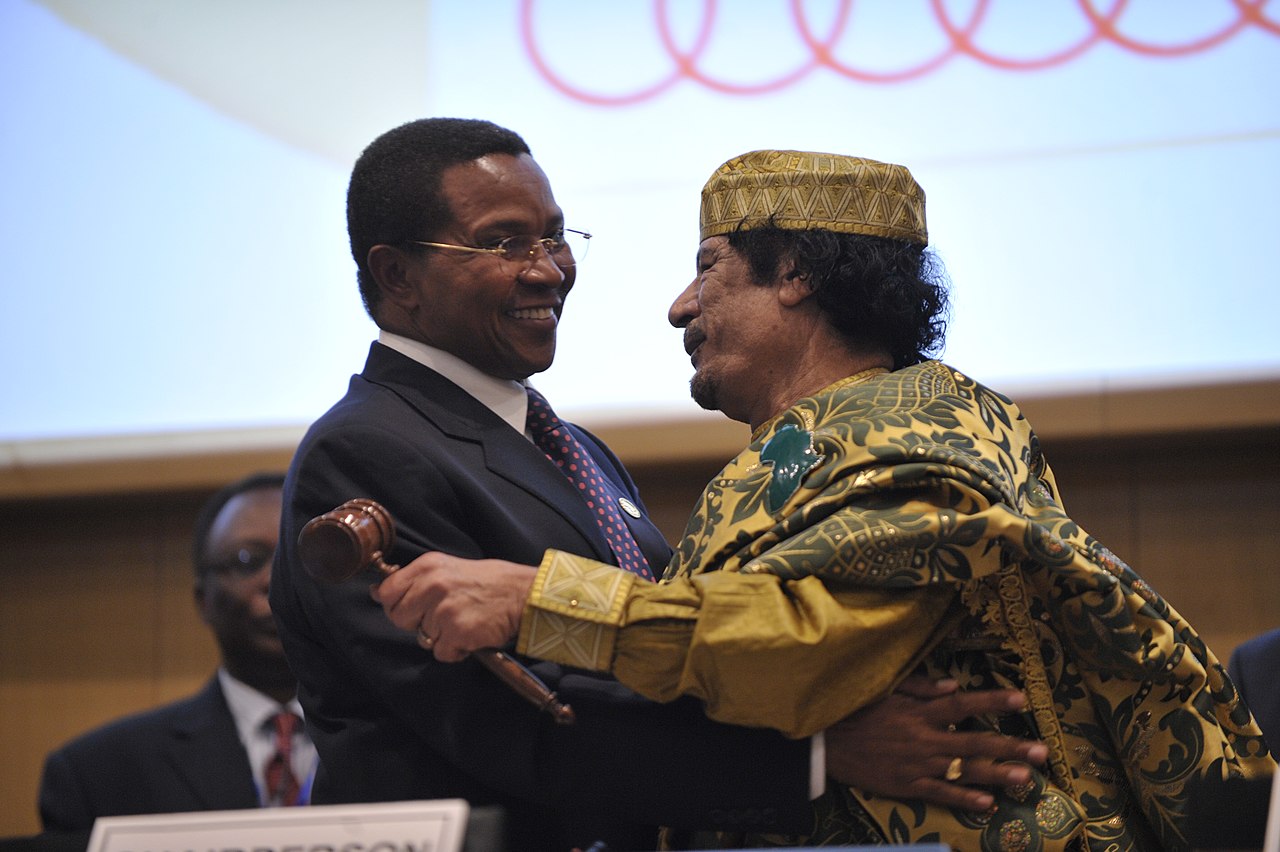
In 2006, the AU decided to create a Committee “to consider the implementation of a rotation system between the regions” in relation to the presidency. Controversy arose at the 2006 summit when Sudan announced its candidacy for the AU’s chairmanship, as a representative of the East African region. Several member states refused to support Sudan because of tensions over Darfur (see also below). Sudan ultimately withdrew its candidacy and President Denis Sassou-Nguesso of the Republic of the Congo was elected to a one-year term. At the January 2007 summit, Sassou-Nguesso was replaced by President John Agyekum Kufuor of Ghana, despite another attempt by Sudan to gain the chair. 2007 was the 50th anniversary of Ghana’s independence, a symbolic moment for the country to hold the chair of the AU—and to host the mid-year summit at which the proposed Union Government was also discussed. In January 2008, President Jakaya Kikwete of Tanzania took over as chair, representing the East African region and thus apparently ending Sudan’s attempt to become chair—at least till the rotation returns to East Africa. The current chair is Benin
List of chairpersons
| Name | Beginning of term | End of term | Country |
|---|---|---|---|
| Thabo Mbeki | 9 July 2002 | 10 July 2003 |  South Africa South Africa |
| Joaquim Chissano | 10 July 2003 | 6 July 2004 |  Mozambique Mozambique |
| Olusegun Obasanjo | 6 July 2004 | 24 January 2006 |  Nigeria Nigeria |
| Denis Sassou-Nguesso | 24 January 2006 | 24 January 2007 |  Congo Congo |
| John Kufuor | 30 January 2007 | 31 January 2008 |  Ghana Ghana |
| Jakaya Kikwete | 31 January 2008 | 2 February 2009 |  Tanzania Tanzania |
| Muammar al-Gaddafi | 2 February 2009 | 31 January 2010 |  Libya Libya |
| Bingu wa Mutharika | 31 January 2010 | 31 January 2011 |  Malawi Malawi |
| Teodoro Obiang Nguema Mbasogo | 31 January 2011 | 29 January 2012 |  Equatorial Guinea Equatorial Guinea |
| Yayi Boni | 29 January 2012 | 27 January 2013 |  Benin Benin |
| Hailemariam Desalegn | 27 January 2013 | 30 January 2014 |  Ethiopia Ethiopia |
| Mohamed Ould Abdel Aziz | 30 January 2014 | 30 January 2015 |  Mauritania Mauritania |
| Robert Mugabe | 30 January 2015 | 30 January 2016 |  Zimbabwe Zimbabwe |
| Idriss Déby | 30 January 2016 | 30 January 2017 |  Chad Chad |
| Alpha Condé | 30 January 2017 | 28 January 2018 |  Guinea Guinea |
| Paul Kagame | 28 January 2018 | Incumbent |  Rwanda Rwanda |
Headquarters

The main administrative capital of the African Union is in Addis Ababa, Ethiopia, where the African Union Commission is headquartered. A new headquarters complex, the AU Conference Center and Office Complex (AUCC), was inaugurated on 28 January 2012, during the 18th AU summit. The complex was built by China State Construction Engineering Corporation as a gift from the Chinese government, and accommodates, among other facilities, a 2,500-seat plenary hall and a 20-story office tower. The tower is 99.9 meters high to signify the date 9 September 1999, when the Organization of African Unity voted to become the African Union. The building cost US$200 million to construct.
On 26 January 2018, five years after the building’s completion, the French Newspaper Le Monde published an article stating that the Chinese government had heavily bugged the building, installing listening devices in the walls and furniture and setting up the computer system to copy data to servers in Shanghai daily. The Chinese government denied that they bugged the building, stating that the accusations were “utterly groundless and ridiculous.” Ethiopian Prime Minister Hailemariam Desalegn rejected the French media report. Moussa Faki Mahamat, head of the African Union Commission, said the allegations in the Le Monde’s report were false. “These are totally false allegations and I believe that we are completely disregarding them.”
Foreign relations
The individual member states of the African Union coordinate foreign policy through this agency, in addition to conducting their own international relations on a state-by-state basis. The AU represents the interests of African peoples at large in intergovernmental organisations (IGOs); for instance, it is a permanent observer at the United Nations General Assembly. Both the African Union and the United Nations work in tandem to address issues of common concerns in various areas. The African Union Mission in United Nations aspires to serve as a bridge between the two Organisations.
Membership of the AU overlaps with other IGOs and occasionally these third-party organisations and the AU will coordinate matters of public policy. The African Union maintains special diplomatic representation with the United States and the European Union.
In 2016, the Union introduced continent-wide passports.
Upon the election of Donald Trump for the presidency of the U.S., in 2017, the latter passed an executive order for a ban on citizens from seven countries with suspected links to terrorism, that concerns three African countries. During the 28th African Union Summit, in Ethiopia, African leaders criticized the ban as they expressed their growing concerns for the African Economy, under Trump’s policies.
Africa–China relations
One of the leading economic partners of the continent has been the People’s Republic of China (PRC). In September 2018, the bloc held its third Forum on China–Africa Cooperation summit in Beijing, China.
Culture
Symbols
The emblem of the African Union consists of a gold ribbon bearing small interlocking red rings, from which palm leaves shoot up around an outer gold circle and an inner green circle, within which is a gold representation of Africa. The red interlinked rings stand for African solidarity and the blood shed for the liberation of Africa; the palm leaves for peace; the gold, for Africa’s wealth and bright future; the green, for African hopes and aspirations. To symbolise African unity, the silhouette of Africa is drawn without internal borders.
The African Union adopted its new flag at its 14th Ordinary Session of the Assembly of Heads of State and Government taking place in Addis Ababa 2010. During the 8th African Union Summit which took place in Addis Ababa on 29 and 30 January 2007, the Heads of State and Government decided to launch a competition for the selection of a new flag for the Union. They prescribed a green background for the flag symbolising the hope of Africa and stars to represent the Member States.
Pursuant to this decision, the African Union Commission (AUC) organised a competition for the selection of a new flag for the African Union. The AUC received a total of 106 entries proposed by citizens of 19 African countries and 2 from the Diaspora. The proposals were then examined by a panel of experts put in place by the African Union Commission and selected from the five African regions for shortlisting according to the main directions given by the Heads of State and Government.
At the 13th Ordinary Session of the Assembly, the Heads of State and Government examined the report of the Panel and selected one among all the proposals. The flag is now part of the paraphernalia of the African Union and replaces the old one.
The old flag of the African Union bears a broad green horizontal stripe, a narrow band of gold, the emblem of the African Union at the centre of a broad white stripe, another narrow gold band and a final broad green stripe. Again, the green and gold symbolise Africa’s hopes and aspirations as well as its wealth and bright future, and the white represents the purity of Africa’s desire for friends throughout the world. The flag has led to the creation of the “national colours” of Africa of gold and green (sometimes together with white). These colours are visible in one way or another in the flags of many African nations. Together the colours green, gold, and red constitute the Pan-African colours.
The African Union has adopted the anthem, “Let Us All Unite and Celebrate Together“.
Source: Wikipedia under the Creative Commons Attribution-ShareAlike License


