


Benin, officially the Republic of Benin and formerly Dahomey, is a country in West Africa. It is bordered by Togo to the west, Nigeria to the east, and Burkina Faso and Niger to the north. The majority of its population lives on the small southern coastline of the Bight of Benin, part of the Gulf of Guinea in the northernmost tropical portion of the Atlantic Ocean. The capital of Benin is Porto-Novo, but the seat of government is in Cotonou, the country’s largest city and economic capital. Benin covers an area of 114,763 square kilometres (44,310 sq mi) and its population in 2016 was estimated to be approximately 10.87 million. Benin is a tropical nation, highly dependent on agriculture, with substantial employment and income arising from subsistence farming.

The official language of Benin is French. However, indigenous languages such as Fon and Yoruba are commonly spoken. The largest religious group in Benin is Roman Catholicism, followed closely by Islam, Vodun and Protestantism. Benin is a member of the United Nations, the African Union, the Organisation of Islamic Cooperation, the South Atlantic Peace and Cooperation Zone, La Francophonie, the Community of Sahel-Saharan States, the African Petroleum Producers Association and the Niger Basin Authority.[
From the 17th to the 19th century, the main political entities in the area were the Kingdom of Dahomey, along with the city-state of Porto-Novo, and a large area with many different nations to the north. This region was referred to as the Slave Coast from as early as the 17th century due to the large number of enslaved people who were shipped to the New World during the Trans-Atlantic slave trade. After enslavement was abolished, France took over the country and renamed it French Dahomey. In 1960, Dahomey gained full independence from France. The sovereign state has had a tumultuous history since then, with many different democratic governments, military coups, and military governments.
A Marxist–Leninist state called the People’s Republic of Benin existed between 1975 and 1990. In 1991, it was replaced by the current multi-party Republic of Benin.
Etymology
During the colonial period and at independence, the country was known as Dahomey. On 30 November 1975, it was renamed to Benin,[ after the body of water on which the country lies—the Bight of Benin. This had been named by Europeans after the Benin Empire in present-day Nigeria. The country of Benin has no connection to Benin City in modern Nigeria, nor to the Benin bronzes. The form “Benin” is the result of a Portuguese corruption of the city of Ubinu (now Benin City).
The new name, Benin, was chosen for its neutrality. Dahomey was the name of the former Fon Kingdom of Dahomey, which was limited to most of the southern third of the present country and therefore did not represent Porto-Novo (a rival Yoruba state in the south), central Benin (which is also dominated by the Yoruba), the multi-ethnic northwestern sector Atakora, nor the Bariba Kingdom of Borgu, which covered the northeastern district.
History
Precolonial history
The current country of Benin combines three areas which had distinctly different political systems and ethnicities prior to French colonial control. Before 1700, there were a few important city-states along the coast (primarily of the Aja ethnic group, but also including Yorubaand Gbe peoples) and a mass of tribal regions inland (composed of Bariba, Mahi, Gedevi, and Kabye peoples). The Oyo Empire, located primarily to the east of modern Benin, was the most significant large-scale military force in the region. It regularly conducted raids and exacted tribute from the coastal kingdoms and the tribal regions. The situation changed in the 1600s and early 1700s as the Kingdom of Dahomey, consisting mostly of Fon people, was founded on the Abomey plateau and began taking over areas along the coast. By 1727, king Agaja of the Kingdom of Dahomey had conquered the coastal cities of Allada and Whydah, but it had become a tributary of the Oyo empire and did not directly attack the Oyo allied city-state of Porto-Novo. The rise of the kingdom of Dahomey, the rivalry between the kingdom and the city of Porto-Novo, and the continued tribal politics of the northern region, persisted into the colonial and post-colonial periods.[
The Dahomey Kingdom was known for its culture and traditions. Young boys were often apprenticed to older soldiers, and taught the kingdom’s military customs until they were old enough to join the army. Dahomey was also famous for instituting an elite female soldier corps, called Ahosi, i.e. the king’s wives, or Mino, “our mothers” in the Fon language Fongbe, and known by many Europeans as the Dahomean Amazons. This emphasis on military preparation and achievement earned Dahomey the nickname of “black Sparta” from European observers and 19th-century explorers such as Sir Richard Burton.[
Portuguese Empire
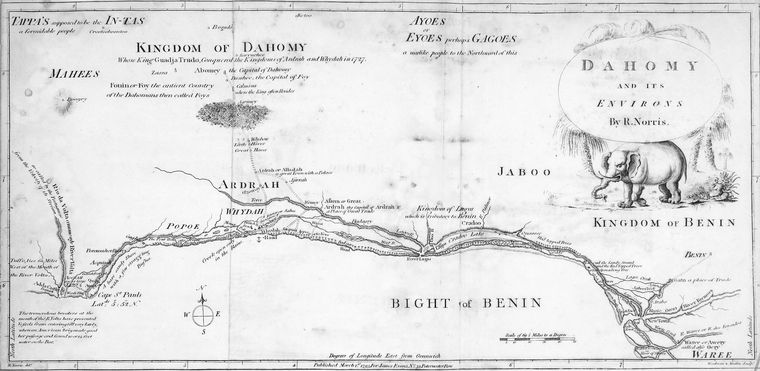
The kings of Dahomey sold their war captives into transatlantic slavery. They also had a practice of killing war captives in a ceremony known as the Annual Customs. By about 1750, the King of Dahomey was earning an estimated £250,000 per year by selling African captives to European slave-traders.[
Though the leaders of Dahomey appear to have initially resisted the slave trade, it flourished in the region of Dahomey for almost three hundred years, beginning in 1472 with a trade agreement with Portuguese merchants. The area was named the “Slave Coast” because of this flourishing trade. Court protocols, which demanded that a portion of war captives from the kingdom’s many battles be decapitated, decreased the number of enslaved people exported from the area. The number went from 102,000 people per decade in the 1780s to 24,000 per decade by the 1860s.

The decline was partly due to the Slave Trade Act 1807 banning the trans-Atlantic slave trade by Britain and the United States following in 1808, followed by other countries.[ This decline continued until 1885, when the last slave ship departed from the coast of the modern Benin Republic bound for Brazil in South America, which had yet to abolish slavery. The capital’s name Porto-Novo is of Portuguese origin, meaning “New Port”. It was originally developed as a port for the slave trade.
Colonial period (1900 until 1958)
By the middle of the nineteenth century, Dahomey had begun to weaken and lose its status as the regional power. This enabled the French to take over the area in 1892. In 1899, the French included the land called French Dahomey within the larger French West Africa colonial region.
In 1958, France granted autonomy to the Republic of Dahomey, and full independence on 1 August 1960, which is celebrated each year as Independence Day, a national holiday.[ The president who led the country to independence was Hubert Maga.[24][25]
Post-colonial period
For the next twelve years after 1960, ethnic strife contributed to a period of turbulence. There were several coups and regime changes, with the figures of Hubert Maga, Sourou Apithy, Justin Ahomadégbé, and Émile Derlin Zinsou dominating; the first three each represented a different area and ethnicity of the country. These three agreed to form a Presidential Council after violence marred the 1970 elections.

On 7 May 1972, Maga ceded power to Ahomadégbé. On 26 October 1972, Lt. Col. Mathieu Kérékou overthrew the ruling triumvirate, becoming president and stating that the country would not “burden itself by copying foreign ideology, and wants neither Capitalism, Communism, nor Socialism”. On 30 November 1974 however, he announced that the country was officially Marxist, under control of the Military Council of the Revolution (CMR), which nationalized the petroleum industry and banks. On 30 November 1975, he renamed the country to the People’s Republic of Benin.[
The CMR was dissolved in 1979, and Kérékou arranged show elections in which he was the only allowed candidate. Establishing relations with China, North Korea, and Libya, he put nearly all businesses and economic activities under state control, causing foreign investment in Benin to dry up. Kérékou attempted to reorganize education, pushing his own aphorisms such as “Poverty is not a fatality”, resulting in a mass exodus of teachers, along with numerous other professionals.[ The regime financed itself by contracting to take nuclear waste, first from the Soviet Union and later from France.
In 1980, Kérékou converted to Islam and changed his first name to Ahmed. He changed his name back after claiming to be a born-again Christian. In 1989, riots broke out when the regime did not have enough money to pay its army. The banking system collapsed. Eventually, Kérékou renounced Marxism, and a convention forced Kérékou to release political prisoners and arrange elections. Marxism–Leninism was abolished as the nation’s form of government.[
The country’s name was officially changed to the Republic of Benin on 1 March 1990, after the newly formed government’s constitution was completed.

In a 1991 election, Kérékou lost to Nicéphore Soglo. Kérékou returned to power after winning the 1996 vote. In 2001, a closely fought election resulted in Kérékou winning another term, after which his opponents claimed election irregularities.
In 1999, Kérékou issued a national apology for the substantial role that Africans had played in the Atlantic slave trade.[
Kérékou and former president Soglo did not run in the 2006 elections, as both were barred by the constitution’s restrictions on age and total terms of candidates.
On 5 March 2006, an election was held that was considered free and fair. It resulted in a runoff between Yayi Boni and Adrien Houngbédji. The runoff election was held on 19 March and was won by Boni, who assumed office on 6 April. The success of the fair multi-party elections in Benin won praise internationally. Boni was reelected in 2011, taking 53.18% of the vote in the first round—enough to avoid a runoff election. He was the first president to win an election without a runoff since the restoration of democracy in 1991.
In the March 2016 presidential elections, in which Boni Yayi was barred by the constitution from running for a third term, businessman Patrice Talon won the second round with 65.37% of the vote, defeating investment banker and former Prime Minister Lionel Zinsou. Talon was sworn in on 6 April 2016. Speaking on the same day that the Constitutional Court confirmed the results, Talon said that he would “first and foremost tackle constitutional reform”, discussing his plan to limit presidents to a single term of five years in order to combat “complacency”. He also said that he planned to slash the size of the government from 28 to 16 members.
Politics
Benin’s politics take place in a framework of a presidential representative democratic republic, in which the President of Benin is both head of state and head of government, within a multi-party system. Executive power is exercised by the government. Legislative power is vested in both the government and the legislature. The judiciary is independent of the executive and the legislature. The political system is derived from the 1990 Constitution of Benin and the subsequent transition to democracy in 1991.
Benin scored highly in the 2013 Ibrahim Index of African Governance, which comprehensively measures the state of governance across the continent. Benin was ranked 18th out of 52 African countries and scored best in the categories of Safety & Rule of Law and Participation & Human Rights.[
In its 2007 Worldwide Press Freedom Index, Reporters Without Borders ranked Benin 53rd out of 169 countries.
Benin has been rated equal-88th out of 159 countries in a 2005 analysis of police, business, and political corruption.
Culture

Arts
Beninese literature had a strong oral tradition long before French became the dominant language.[Félix Couchoro wrote the first Beninese novel, L’Esclave (The Slave), in 1929.

Post-independence, the country was home to a vibrant and innovative music scene, where native folk music combined with Ghanaian highlife, French cabaret, American rock, funk and soul, and Congolese rumba.
Singer Angélique Kidjo and actor Djimon Hounsou were born in Cotonou, Benin. Composer Wally Badarou and singer Gnonnas Pedro are also of Beninese descent.
Biennale Benin, continuing the projects of several organizations and artists, started in the country in 2010 as a collaborative event called “Regard Benin”. In 2012, the project became a Biennial coordinated by the Consortium, a federation of local associations. The international exhibition and artistic program of the 2012 Biennale Benin are curated by Abdellah Karroum and the Curatorial Delegation.
A number of Beninese artists have received major international recognition, such as Georges Adéagbo, Meschac Gaba, Romuald Hazoumè, Dominique Zinkpè or Emo de Medeiros.
Customary names
Many Beninese in the south of the country have Akan-based names indicating the day of the week on which they were born. This is due to influence of the Akan people like the Akwamu and others.[
Language
Local languages are used as the languages of instruction in elementary schools, with French only introduced after several years. In wealthier cities, however, French is usually taught at an earlier age. At the secondary School level, local language is generally forbidden and French is the sole language of instruction. Beninese languages are generally transcribed with a separate letter for each speech sound (phoneme), rather than using diacritics as in French or digraphs as in English. This includes Beninese Yoruba, which in Nigeria is written with both diacritics and digraphs. For instance, the mid vowels are written é è, ô, o in French are written e, ɛ, o, ɔ in Beninese languages, whereas the consonants are written ng and sh or ch in English are written ŋ and c. However, digraphs are used for nasal vowels and the labial-velar consonants kp and gb, as in the name of the Fon language Fon gbe /fõ ɡ͡be/, and diacritics are used as tone marks. In French-language publications, a mixture of French and Beninese orthographies may be seen.
Cuisine

Acarajé is peeled black-eyed peasformed into a ball and then deep-fried.Main article: Benin cuisine
Beninese cuisine is known in Africa for its exotic ingredients and flavorful dishes. Beninese cuisine involves fresh meals served with a variety of key sauces. In southern Benin cuisine, the most common ingredient is corn, often used to prepare dough which is mainly served with peanut- or tomato-based sauces. Fish and chicken are the most common meats used in southern Beninese cuisine, but beef, goat, and bush rat are also consumed. The main staple in northern Benin is yams, often served with sauces mentioned above. The population in the northern provinces use beef and pork meat which is fried in palm or peanut oil or cooked in sauces. Cheese is used in some dishes. Couscous, rice, and beans are commonly eaten, along with fruits such as mangoes, oranges, avocados, bananas, kiwi fruit, and pineapples.
Meat is usually quite expensive, and meals are generally light on meat and generous on vegetable fat. Frying in palm or peanut oil is the most common meat preparation, and smoked fish is commonly prepared in Benin. Grinders are used to prepare corn flour, which is made into a dough and served with sauces. “Chicken on the spit” is a traditional recipe in which chicken is roasted over a fire on wooden sticks. Palm roots are sometimes soaked in a jar with salt water and sliced garlic to tenderize them, then used in dishes. Many people have outdoor mud stoves for cooking.
Sports
Football is generally considered the most popular sport in Benin. In the past decade, baseball has been introduced to the country
Source: Wikipedia under the Creative Commons Attribution-ShareAlike License


