
Breaking the Glass Ceiling in African AI Labs


Across Africa’s leading AI hubs, women innovators are not just entering the room — they’re rewriting the code of the future. From ethical frameworks to cutting‑edge breakthroughs, their leadership is redefining the STEM gender narrative.
The Numbers Behind the Narrative
Despite Africa’s booming AI sector, women remain under‑represented in technical and leadership roles. In South Africa, women make up just 13% of STEM graduates and 39.5% of the ICT workforce. Across the continent, the gender gap in AI mirrors — and in some cases exceeds — these figures, with structural barriers limiting women’s participation from school through to senior research posts.
The African Advanced Level Telecommunications Institute (AFRALTI) recently launched the Network of African Women in AI, highlighting both the urgency and opportunity: to design inclusive AI systems, women must be present at every stage — from data collection to deployment.
Shaping Ethical AI
Two of the most influential voices in global AI ethics have African roots:
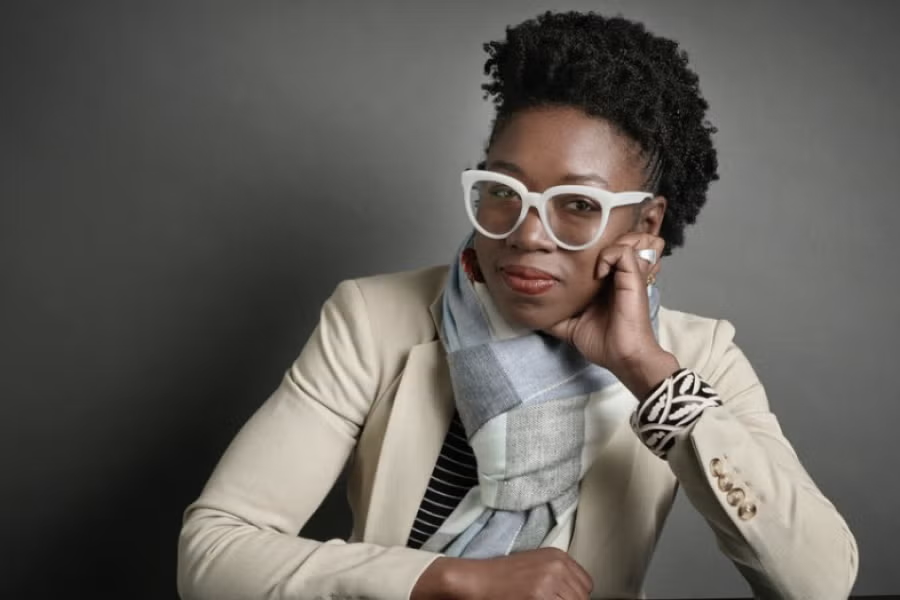

- Joy Buolamwini — Ghanaian‑American computer scientist and founder of the Algorithmic Justice League, whose MIT research exposed racial and gender bias in facial recognition systems. Her work has pushed tech giants to audit and improve their models, and she continues to advise governments on AI accountability.
- Timnit Gebru — Ethiopian‑born founder of the Distributed Artificial Intelligence Research Institute (DAIR) and co‑founder of Black in AI. Gebru has been a leading critic of large language models’ environmental and ethical costs, and advocates for AI that serves African communities rather than replicating Silicon Valley’s biases.
Both argue that ethical AI frameworks must be grounded in Africa’s socio‑political realities — from protecting marginalised groups to ensuring data sovereignty.
Institutional Enablers — and Barriers
A Science for Africa Foundation policy review found that while some African countries reference gender in AI strategies, implementation is often weak due to insufficient funding, lack of awareness, and poor coordination. Key barriers include:
- Digital gender divide — Women and girls are less likely to have internet access, limiting their ability to participate in AI development.
- Data gaps — Lack of gender‑sensitive datasets leads to biased algorithms.
- Pipeline attrition — Cultural norms, lack of role models, and inflexible work environments push women out of STEM as they advance.
On the enabling side, initiatives like the African Observatory on Responsible AI’s Women in Focus scholarships and Women in Tech Africa are building capacity through training, mentorship, and policy engagement.
Building the Pipeline

From coding bootcamps like She Code Africa to corporate‑backed accelerators, the ecosystem for African women in AI is growing. In April 2025, South Africa’s Women in Technology and Innovation Programme was launched to provide funding, mentorship, and IP protection for women‑led tech ventures.
These programmes are not just about skills — they’re about visibility. As more women lead AI projects in health, agriculture, and climate modelling, they challenge stereotypes and inspire the next generation.
10 Years of African Women in Tech Milestones
| Year | Milestone |
| 2015 | Launch of Women in Tech Africa, now spanning 30+ countries |
| 2016 | Joy Buolamwini founds the Algorithmic Justice League |
| 2017 | Soronko Academy (Ghana) expands coding for girls to 20,000+ participants |
| 2018 | Timnit Gebru co‑founds Black in AI |
| 2019 | Women Techsters initiative sets goal to train 5 million women by 2030 |
| 2021 | UN EQUALS Award to Women in Tech Africa for leadership in women & tech |
| 2022 | First pan‑African AI ethics policy dialogues include gender mainstreaming |
| 2023 | She Code Africa launches AI/ML track for women developers |
| 2024 | African Observatory on Responsible AI launches Women in Focus scholarships |
| 2025 | South Africa’s Women in Technology and Innovation Programme debuts |
The Road Ahead
Closing the STEM gender gap in AI will require policy reform, targeted investment, and cultural change. But the momentum is building: women are not only contributing to Africa’s AI revolution — they’re steering it toward a more inclusive, ethical future.
As Buolamwini told a recent audience, “We have the opportunity to encode our values into the systems that will shape tomorrow. Let’s make sure those values include all of us.”


